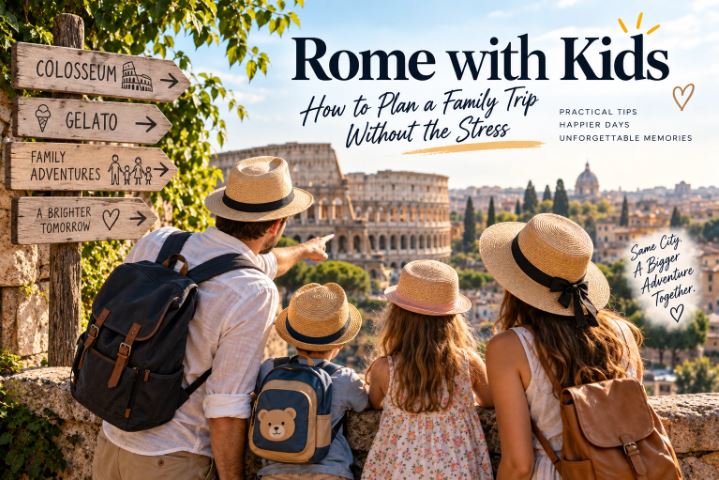

Planning Rome with kids? Discover family-friendly neighborhoods, attractions, transport tips, stroller advice and a practical 4-day family itinerary.
Rome can be an extraordinary city for children, but only if you stop planning it like an adult sightseeing marathon.
A well-structured Rome travel guide can help families combine major landmarks with practical transport, quieter neighborhoods, parks and enough downtime between attractions.
A typical first-time itinerary might include the Colosseum, Roman Forum, Vatican Museums, Pantheon, Trevi Fountain and several churches in one or two days. For adults, that is ambitious. With children, it can quickly become exhausting.
The key to a successful family trip is not seeing fewer interesting places. It is changing how you organize the day.
Shorter sightseeing blocks, strategic transport, parks, food breaks and choosing the right neighborhood can make the difference between children remembering Rome as an adventure and remembering it as a very long walk.
What You'll Discover:
Is Rome Good for Families?
Yes, but Rome rewards realistic planning.
The city offers ancient ruins, fountains, castles, parks, interactive museums, gelato shops and enormous piazzas that can make history feel much more tangible than it does in a classroom.
At the same time, Rome has practical challenges for families:
- cobblestones
- crowded public transport
- long museum visits
- summer heat
- stairs and uneven surfaces
- substantial walking distances
That is why a useful guide to Rome with kids should focus not only on attractions but also on the logistics of moving, eating and resting as a family.
Follow the Two-Hour Rule
One of the easiest mistakes is expecting children to maintain adult concentration through several consecutive hours of monuments and museums.
A better approach is to divide the day into blocks.
For example:
- Morning: one major attraction
- Late morning: snack or gelato
- Lunch: relaxed meal
- Afternoon: park, interactive museum or lighter attraction
- Evening: piazza, neighborhood walk and dinner
For younger children, cultural visits of around two hours or less are often easier to manage than one long sequence of churches, ruins and museums.
This is especially useful around the Colosseum and Vatican, where the amount of information can overwhelm even adults.
Colosseum With Children: Make It a Story, Not a Lecture
The Colosseum is one of the easiest Roman landmarks for children to understand visually.
Instead of explaining every architectural detail, build the visit around a few simple ideas:
- Who came here?
- What happened in the arena?
- How many people could enter?
- How did Romans reach their seats?
Children tend to engage more when the place becomes a story rather than an archaeology lesson.
The challenge begins after the Colosseum.
The Roman Forum and Palatine Hill involve uneven terrain, little shade in some areas and much more walking. Families with small children should be realistic about how much of the archaeological park they want to cover in one visit.
A short pause afterwards can be more valuable than immediately adding another major attraction.
Combine Ancient Rome With a Green Break
A useful family strategy is pairing monuments with nearby green space.
After the Colosseum area, for example, families can consider moving toward Villa Celimontana rather than immediately continuing with another indoor visit.
Children get space to move without being told to stay quiet, while adults get a much-needed break.
This monument-plus-park pattern works well throughout Rome.
The idea is simple:
after a high-focus activity, schedule a low-focus activity.
It keeps the day moving without making every hour educational.
Vatican Museums: Know Your Child Before You Book
The Vatican Museums can be wonderful for older children interested in art, mythology or history.
But they are also enormous.
The biggest mistake is assuming that because the Sistine Chapel is famous, every child will enjoy several hours of galleries leading up to it.
Ask yourself:
- Does your child enjoy museums?
- Can they handle crowds?
- Are they comfortable walking for several hours?
- Will they be interested in paintings and sculpture?
If the answer is mostly no, a shorter Vatican-focused experience may make more sense than attempting to see everything.
Also remember that the Vatican Museums entrance is on Viale Vaticano rather than directly in St. Peter’s Square. With children, avoiding unnecessary walking matters even more.
Which Areas of Rome Work Best for Families?
The best family neighborhood is not necessarily the most picturesque one.
When traveling with children, practical features can matter more:
- wide sidewalks
- nearby supermarkets
- pharmacies
- access to parks
- transport connections
- flat terrain
Prati
Prati is one of the strongest options for families who want order and convenient transportation.
Its streets are generally wider than the tiny lanes of the historic center, and Metro A makes it useful for reaching other parts of the city.
JustRoma also highlights the practical advantages of Prati for families, including wider sidewalks and easy access to daily services.
Flaminio
Flaminio works well for families who value parks and cultural spaces.
Villa Borghese is nearby, and the area gives children more room than the dense historic center.
Historic Center
Staying in the historic center reduces some transportation needs but creates other challenges.
Cobblestones, crowds and limited supermarket space can make daily family logistics less convenient than the location initially suggests.
Testaccio
Testaccio is useful for families looking for a more residential Roman experience.
Local markets, playgrounds and a less tourist-heavy atmosphere can make everyday routines easier.
Don’t Underestimate the Stroller Problem
Rome and strollers are not always natural partners.
Cobblestones look beautiful in photographs but can become uncomfortable after hours of pushing a stroller.
Neighborhoods such as Monti can also include slopes and stairs that seem insignificant on Google Maps but become much more noticeable with a child, bags and summer heat.
Before choosing accommodation, inspect not just the distance to attractions but also:
- street surface
- hills
- stairs
- nearest metro or tram stop
- whether the building has an elevator
This is one of those details that generic hotel rankings rarely explain.
How to Get Around Rome With Children
Families should think about Rome transport differently from solo travelers.
The goal is not simply to find the cheapest option.
The goal is to avoid wasting children’s energy on journeys that add nothing to the day.
A practical guide to how to get around Rome helps because the most efficient choice changes according to distance, traffic and destination.
Walk for Short Distances
Central Rome is best experienced on foot when attractions are close together.
If two sights are within roughly one to one-and-a-half kilometers, walking may be easier than finding a bus, especially with a stroller.
Use the Metro for Longer Cross-City Journeys
Metro travel is particularly useful when moving between major zones such as Termini, the Vatican and the Colosseum.
Unlike buses and taxis, the metro avoids surface traffic.
Avoid Unnecessary Bus Journeys at Rush Hour
Surface traffic can slow dramatically during busy periods.
JustRoma specifically advises avoiding buses during approximately 08:00–09:30 and 17:30–19:30 when possible, because walking or metro can be more predictable.
Use Taxis Strategically
A taxi can be worth the additional cost when:
- children are exhausted
- it is late
- you have luggage
- the route is awkward by public transport
- you are returning from a distant neighborhood
With a family, paying for one strategic taxi can sometimes save an hour of frustration.
A Practical 4-Day Rome Family Itinerary
| Day | Morning | Afternoon | Evening |
| 1 | Colosseum | Park or rest break | Monti and early dinner |
| 2 | Vatican area | Castel Sant’Angelo or relaxed Prati walk | Dinner in Prati |
| 3 | Pantheon & Piazza Navona | Villa Borghese | Trevi Fountain |
| 4 | Children’s museum or family activity | Testaccio or Trastevere | Relaxed final dinner |
Notice that the plan does not attempt to fill every hour.
That is intentional.
Families often enjoy Rome more when one part of the day remains flexible.
Villa Borghese: The Family Reset Button
Villa Borghese is particularly useful because it can interrupt a sightseeing-heavy day.
Children get open space to run, while adults can enjoy one of Rome’s most pleasant central green areas.
It also combines naturally with attractions around Piazza del Popolo, the Spanish Steps and the Borghese Gallery area.
If the previous day involved the Forum or Vatican Museums, spending part of the next afternoon outdoors can dramatically improve the rhythm of the trip.
Consider an Interactive Museum
Traditional art museums are not the only cultural option in Rome.
Interactive children’s spaces can work particularly well when the weather is poor or when younger travelers have reached their limit for ancient statues.
Explora, near the Flaminio area, is one of the city’s better-known child-focused options.
For families, it can also serve a strategic purpose: giving children an activity designed specifically for them instead of expecting them to adapt to adult sightseeing all week.
Food Is Part of the Family Strategy
Italian food is generally easy for children to approach.
Pizza, pasta, supplì and gelato provide familiar entry points even for selective eaters.
But mealtime strategy matters.
Avoid waiting until everyone is exhausted and hungry before searching for a restaurant.
A better rhythm is:
attraction → snack → short activity → lunch
rather than:
three attractions → long walk → desperate restaurant search.
Markets can also work well because different family members can choose different foods without committing to a formal meal.
Testaccio Market is particularly useful for this type of flexible lunch.
Visit Trevi Fountain Earlier Than You Think
Trevi Fountain can become extremely crowded.
For families, early morning has an advantage beyond better photographs: children have space to see what is happening instead of experiencing the fountain from behind several rows of adults.
The same principle applies to Piazza Navona.
Rome’s great public spaces are often far more family-friendly before peak crowds arrive.
Don’t Chase Every “Must-See”
Children will not remember Rome according to TripAdvisor rankings.
They may remember:
- feeding their curiosity at the Colosseum
- running in Villa Borghese
- watching street artists in Piazza Navona
- choosing gelato flavors
- seeing a fountain at night
- riding the metro
- eating pizza in a neighborhood square
That is not a lesser version of Rome.
For families, it may be the better one.
Family Travel Mistakes to Avoid
Too Many Timed Reservations
Three timed attractions in one day leave very little room for delays, tiredness or unexpected needs.
One major reservation per day is often enough.
Crossing Rome Repeatedly
Do not visit the Vatican in the morning, the Colosseum after lunch and Trastevere before dinner just because all three appear on a checklist.
Group places geographically.
Ignoring Heat
In warmer months, schedule outdoor archaeological sites earlier in the day when possible.
Use the hottest part of the afternoon for lunch, museums or rest.
Choosing a Hotel Only by Price
A cheaper hotel can become expensive in time and energy if it requires several additional journeys every day.
Planning Only Adult Activities
Children need at least some moments that exist specifically for them.
A playground, park or interactive museum can completely change the mood of the trip.
Frequently Asked Questions About Rome With Kids
Is Rome suitable for young children?
Yes. Rome offers parks, piazzas, fountains and family-friendly attractions, but parents should reduce long walking days and build regular breaks into the itinerary.
What is the best neighborhood in Rome for families?
Prati is a strong all-round choice because of its wider streets, services and Metro A access. Flaminio is attractive for green space, while Testaccio offers a more residential atmosphere.
Can you take a stroller around Rome?
Yes, but cobblestones, hills and stairs can make some areas difficult. A durable stroller with good wheels is much more practical than a lightweight model designed mainly for smooth surfaces.
Is the Colosseum good for children?
Usually yes, particularly when the visit is presented as a story rather than a long history lesson. Families should be more cautious about combining the Colosseum with several additional hours around the Forum and Palatine.
Is the Vatican suitable for children?
It depends on age and interest. Older children interested in art and history may enjoy it, while younger children can struggle with the length and crowds of the Vatican Museums.
Do families need a car in Rome?
Usually not for a central sightseeing trip. Walking, metro and occasional taxis are generally more practical than driving and parking in central Rome.
How many days should a family spend in Rome?
Four to five days gives families a good balance between major attractions and slower activities. Three days is possible but requires more disciplined planning.
What is the best way to get around Rome with children?
Walk within individual sightseeing areas, use the metro for longer journeys and consider taxis when children are tired or routes are inconvenient.
Rome With Kids Is About Rhythm
Family travel in Rome becomes easier when you stop measuring success by the number of monuments visited.
Choose one major focus for each day.
Combine history with green space.
Use public transport strategically.
Stay somewhere that makes daily routines manageable.
Leave enough time for meals, gelato and the unexpected.
Children do not need to understand every century of Roman history to enjoy the city.
They need enough energy and space to become curious about it.
And when the itinerary gives them that opportunity, Rome can become one of the most memorable family destinations in Europe.